Updated: see below.
While posting recently about the rocks here, I mentioned that the red ones often contained plant fossils. By request, here they are.

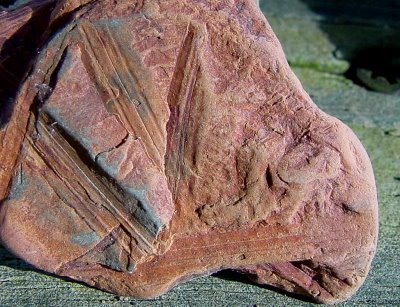
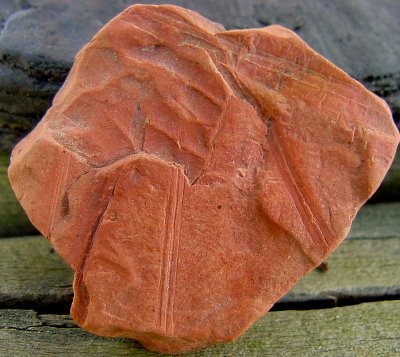
I'll post more fossil pics later this week and try to come up with some IDs.
These are possibly leaves of Lycopods -
Lepidophylloides maybe. Like this and this. The ancient lycopod tree had different types of leaves, and the grass-like ones were called
Lepidophyllum. I believe that would put them in the Pennsylvanian period, about 300 million years ago.
But I'm not sure about that. I've never found any more entire leaf impressions than these. So if you know differently please tell me.
They could possibly be from the other clubmoss tree, the Sigillaria, or the horsetail tree, the Calamites. (They are all from roughly the same time period.)
Updated: I found this at the Virtual Paleontology Lab, which explains why the leaves can have a different scientific name than the rest of the plant:
Because we don't always know which leaves belong to which seeds when they are first discovered, we use the convention of form taxa. When organs are found isolated (not in organic connection), each type of leaf and seed is given its own binomial name (genus and species name according to the International Code of Botanical Nomenclature), without making any assumption about what belongs to what. To use the example discussed by Oliver and Scott (1904), leaves were described as Lyginopteris (genus only for brevity), seeds as Lagenostoma, and stems as Lyginodendron. The similarity of the first syllable gives a hint that the describing paleobotanists (others besides Oliver and Scott) suspected some relationship, but were unable to make a strong inference link. The last syllable of each name gives a hint to the organ type: "dendron" = stem, "pteris" is often used for frond-like foliage, "stoma" = seed. However, after Oliver and Scott's recognition of the unique glands on Lagenostoma lomaxi and species in the other organ form genera, they were able to make the whole-plant link with greater confidence. The whole plant then takes the name of the organ first described, in this case Lyginopteris. When you are writing, take care to make clear whether you are talking about form taxa (organs) or whole-plants.
Also, this is what the globe looked like 300 million years ago. Plate tectonics! Continental drift! Gotta love it.
If I'm right about what these are, the fossils pre-date dinosaurs. Pretty cool.
Here's what it's thought to have looked like around here at that time, more or less. There are modern relatives of some of these ancient plants, such as the plant-rescue ground cedar I tried (unsuccessfully, as it turns out) to transplant here last year.
Sue the T-rex? Sniff. Ho hum. My fossils are older than that. Almost five times older! Now if I could only find somebody to pay me $8 million for them...
-----
P.S. I have learned so much since I started writing this blog - looking all this stuff up so I can pretend like I know what I'm talking about.


 The Headwall Couloir...
 Tahoma Creek Trail was destroyed below the suspension bridge/Wonderland Trail. Last fall, glacier outbursts from a heavy rain storm took out some of the westside road and Tahoma Creek Trail. The trail washout, in particular, was rather amazing. The original trail abruptly disappears into a creek bed of gravel, rock and boulders. What was once an old growth forest, moss, downed trees, dense vegatation, is now a creek bed with gigantic trees. The forest floor is buried. In all, about 1/2 mile of the trail is wiped out.
 As for the climbing route... The team reported a few problem, the first significant one being a dropped set of tent poles. This would make things difficult later on. Also, and maybe more importantly, they selected a route up St. Andrews Rock that cost them a day of travel... This exposure left them more vulnerable to the changing weather. And that's what happened, wind, snow, /12 a tent, and a snow shelter... It made for an interesting night.
  After losing the effectiveness of one tent, and a day of travel, the team reluctantly retreated with plans of returning. Despite not summiting, they felt the route was a go! Here is a closer picture of the Amphitheater and upper Puyallup Glacier.
